The Edge
We Built Our Edge in the World's Toughest Market. Now Every Market Is Becoming Like It.
Our advantage was developed trading digital assets on-chain. Bonds, commodities and equities are moving onto the same rails. The edge we built for one asset class now applies to all of them.
The Market’s Raw Ledger, Published in Full
A traditional market publishes its price in real time and the economics behind it weeks later, filtered through quarterly reporting. A blockchain publishes both at once. Every transfer, balance, and contract call is recorded block by block, around the clock. From that record, the engine derives how supply is distributed across investor cohorts, where liquidity is building, how intensely a network is used, what it earns in fees, and which cohorts are accumulating or distributing. Once a block is final, nothing in it can be restated.
Reading that record is an engineering problem before it is a research problem. Blocks arrive as unstructured transactions. Turning them into a signal requires direct node access, labeling addresses as entities and cohorts, and a point-in-time history that records what was knowable at each block. Without that history, a backtest quietly borrows from the future. QTES was built around it from the start. Research began in 2017.
The Financial System Is Becoming Machine-Readable
Real-world assets are now traded on-chain. Crude oil, gold, bonds, equity indices and single stocks change hands in decentralised markets that never close, while their primary exchanges still shut every evening and every weekend. Regulators have begun to give this transition a legal frame.
For us this is larger than the growth of any single venue. A growing share of the financial system is becoming machine-readable, continuously traded and reachable through the infrastructure we spent nine years building. New venues bring fragmented liquidity, price differences between markets and round-the-clock price discovery in assets that used to sleep. Each of these is a source of return for a system built to see them.
It also raises capacity. More markets mean more volume the engine can trade, less dependence on any one of them and slower decay of any single signal.
Data
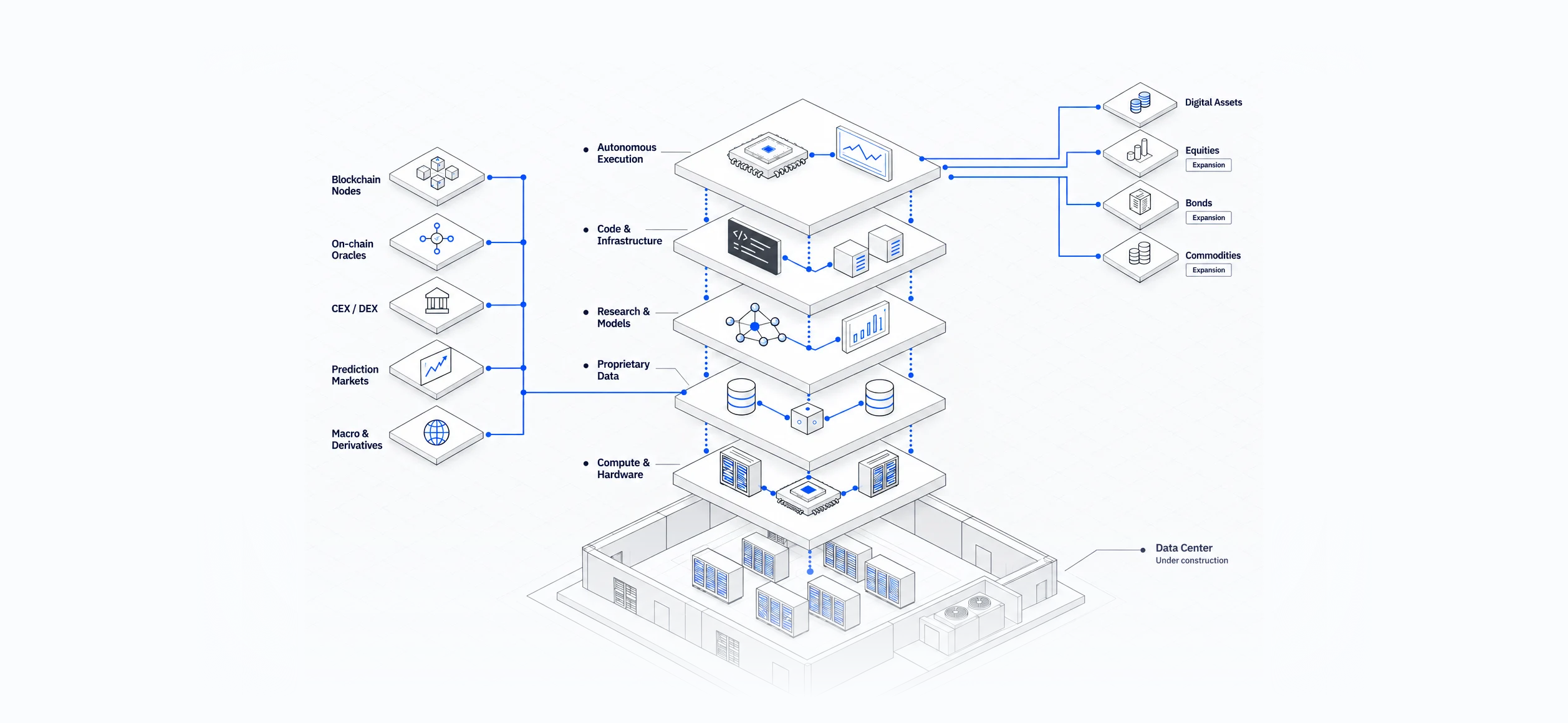
Direct integration with blockchain nodes, on-chain oracles, centralised and decentralised exchanges, prediction markets, macro data, derivatives data and all other types of traditional market feeds. A proprietary history of what the chain looked like at every moment, which cannot be bought.
Execution
Signal to order without a human in between. Execution research works at block-interval resolution, shortening the time between on-chain consensus and a filled trade and moving fills from taker to maker to earn the spread instead of paying it.
Research
We have been researching these markets since 2017, through two full boom-and-bust cycles. Every signal has an economic rationale we can state and a record across those regimes we can show. Candidates run in parallel with live trading before they are allowed near capital. Most are rejected.
Ownership
The full stack is ours: code, data, models, hardware for compute, with our own data centre under construction. Frontier AI models are available to anyone who asks. Our data, research methods, nine years of experience and infrastructure are not.
Proven in Digital Assets. Extending Across All Asset Classes
Our live track record was earned in the deepest and most liquid on-chain asset, Bitcoin, and we concentrated on it deliberately: depth before breadth. The same data pipelines and execution systems are now being extended to on-chain markets for equities, commodities and other real-world assets. New markets enter production the way every strategy does, after they have proven themselves in live testing.