The Engine
Autonomous From Signal to Order
From raw data to executed trade, QTES operates as one fully integrated system, engineered entirely in-house from the first line of code.
The QTES Architecture
QTES combines advanced technologies with mathematical and statistical methods in the design and execution of its investment programs. The proprietary trading engine is capable of systematically identifying investment strategies that deliver exceptional risk-adjusted returns for investors across all market conditions and of algorithmically allocating to the identified portfolio strategies, thereby removing human bias.
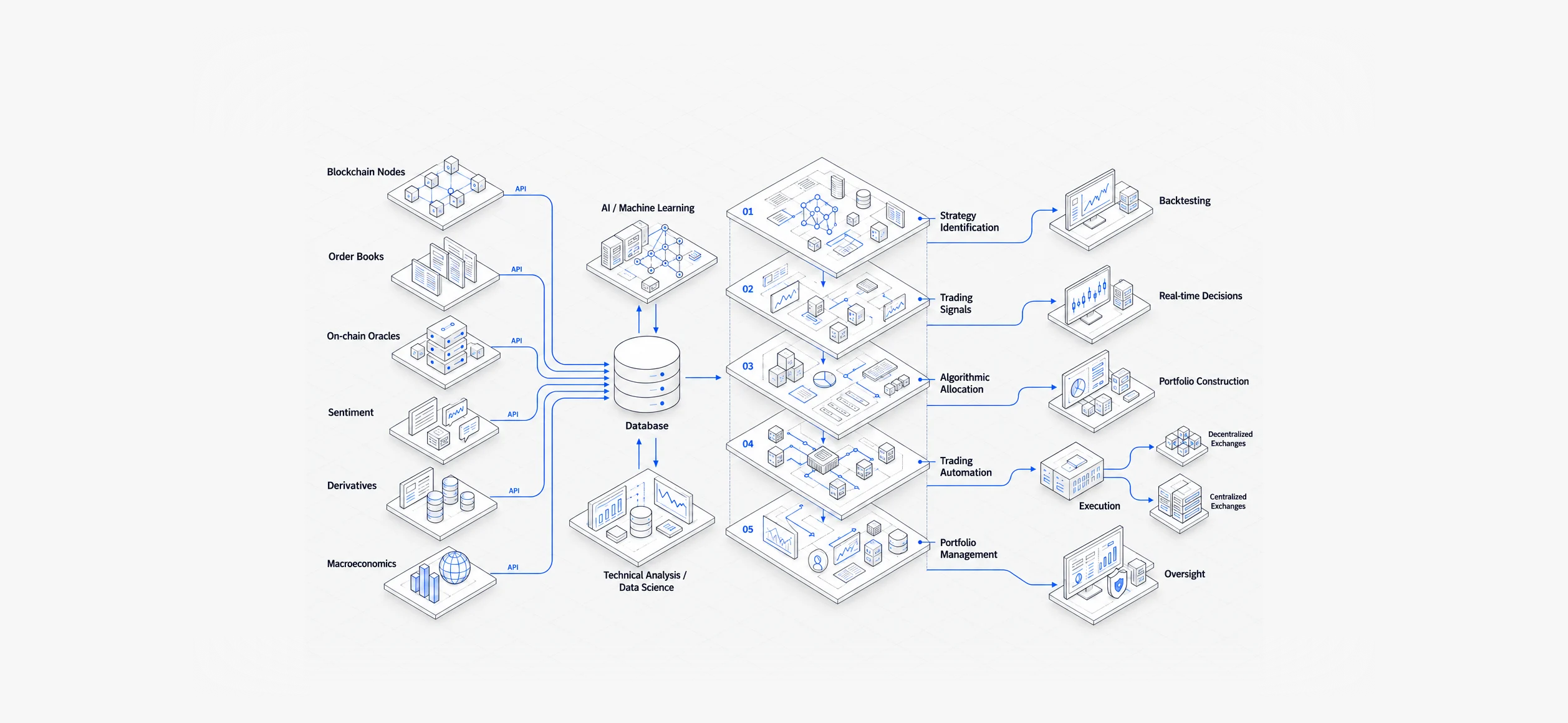
The quantitative trading engine seamlessly integrates with various data sources, including blockchain nodes, on-chain oracles, centralized and decentralized exchanges, prediction markets, traditional markets, macro data feeds, and more, via APIs (application programming interfaces). This connectivity enables the engine to continuously monitor crucial data points, including on-chain user behavior, network economics, and performance in the equity, bond, and futures markets, both historically and in real time.
QTES’s early lead in synthesizing real-time on-chain data into actionable trading strategies is the future of trading and the foundation of QTES. As blockchains become the core financial infrastructure of the New Monetary System, they unlock the delays of periodic corporate reporting that lead to inefficient equity pricing. Blockchain data begins as unstructured transactions within a block, and QTES has been designed from the ground up to derive trading signals from the chain's state.
The highly technical Saidler & Co team contextualizes and synthesizes data using data science, machine learning, artificial intelligence, and traditional investment management best practices. The aim is to identify leading indicators for future price movements and assess their statistical relevance. Based on these observations, the trading engine is designed to generate trading signals for our portfolio managers and execute trades automatically through algorithmically constructed portfolios.
The QTES Architecture in Layers
QTES continuously monitors markets, analyses new data and turns it into trading decisions. Like a blockchain, it processes each change in market conditions as a new state. Every decision passes through five distinct layers, each performing a defined function and passing its output to the next. No order reaches the market without completing all five.
Data Ingestion Layer
Each source is monitored for completeness and latency, and any missing or late input is automatically detected and resolved. Output: Timestamped Raw Events.
State Layer
Raw transactions are decoded and normalized into a single model of each market: supply by holder cohort, exchange flows, network activity, fee revenue, funding, open interest, and price. Every value is stored as it was known at the block it appeared. Research therefore never sees the future, and any moment in history can be replayed exactly. Output: Market State.
Signal Layer
A signal is a function of state. It maps the current state to a directional view and carries three attributes: a stated economic rationale, a validated record across market regimes, and a measured rate of decay. Signals are continuously tracked against one another, so redundancy and failure surface early. Output: scored views.
Allocation Layer
Scored views are combined into one target exposure. The flagship is long or cash, sized by signal strength, with no leverage. Risk limits apply here, before an order exists. Output: target position.
Execution Layer
The difference between current and target position becomes orders, timed to the block interval and routed by venue liquidity. Production execution is taker-based today. Maker execution, which earns the spread rather than paying it, is in live testing and is scheduled for production starting in the fourth quarter of 2026. Output: filled trades, reconciled against target.
Supervision
One layer spans the other five. It measures ingestion completeness, signal drift, fill quality, and the gap between expected and realized behavior. Known faults resolve automatically. Unknown ones are escalated to the team. Research decides which signals enter the engine. The engine decides everything after that. Language models accelerate research and engineering. None of them sits in the path from state to order.
Rejection Is the Default
AI has multiplied the number of ideas we can test. It has not lowered the bar for trading them. Every strategy developed passes through a series of steps. A candidate strategy is validated out-of-sample, then run in parallel with the live portfolio under real market conditions. Only what proves itself there is promoted, and promotion into production is treated as an investment decision in its own right.
- Hypothesis: A stated economic mechanism, fully discussed and vetted by the team before the data is examined
- Out-of-Sample Research: The hypothesis is tested on historical data, with some data withheld from backtests, so the strategy can be tested on data the research never saw.
- Live Testing: A live test is performed alongside the flagship strategies under real market conditions.
- Promotion: Admitted to production after a year of monitoring the strategy’s performance in real time.
- Maintenance and End of Life: Strategies are closely evaluated for signal decay and comparison to backtest performance. Improvement or retirement is considered for strategies that fail to meet performance thresholds.
Our flagship portfolio, QTES V, holds the best strategy from each development series, and each made it through the development pipeline while trading live for at least a year before being admitted. Today the flagship runs three strategies. We understand why each one works, how it behaves when markets turn, and what it contributes to the whole.
The QTES Architecture
| Portfolio | QTES Portfolio V |
| Asset | Bitcoin |
| Positioning | Long or cash, sized by signal strength |
| Leverage | None |
| Execution | Fully algorithmic |
| Live since | July 2023 |
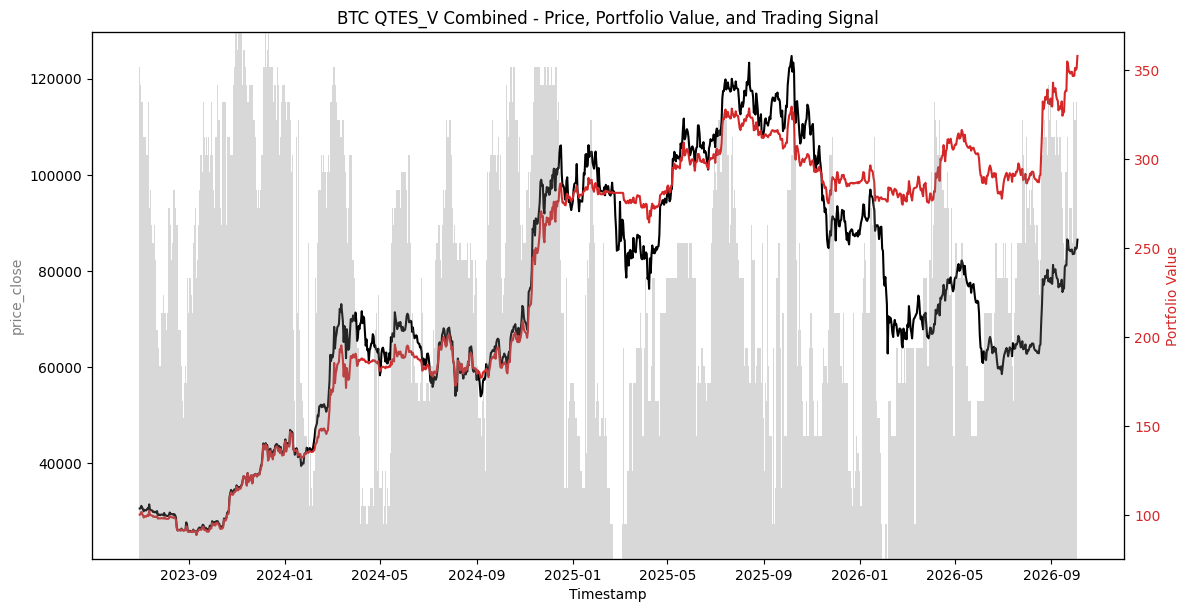
The flagship is deliberately simple in what it holds and sophisticated in when it holds it. It is long Bitcoin when the signals support it and moves partly or wholly into cash when they do not. That is how the engine has kept its deepest drawdown to 21.6% in an asset that fell 73.1%.
When the Engine is Invested
Signals Decay. QTES Does Not
Every signal fades with time. We renew ours faster than they fade, and three lines of work are under way.
Improved Order Management System
Moving from taker-based execution to cost and price improvements through maker execution. We expect to bring it into production from the fourth quarter of 2026.
Breadth
Moving from taker-based execution to cost and price improvements through maker execution. We expect to bring it into production from the fourth quarter of 2026.
New markets
Our data and execution infrastructure is being extended into decentralised markets for equities, commodities, perpetual futures and prediction markets, and into market-neutral strategies.